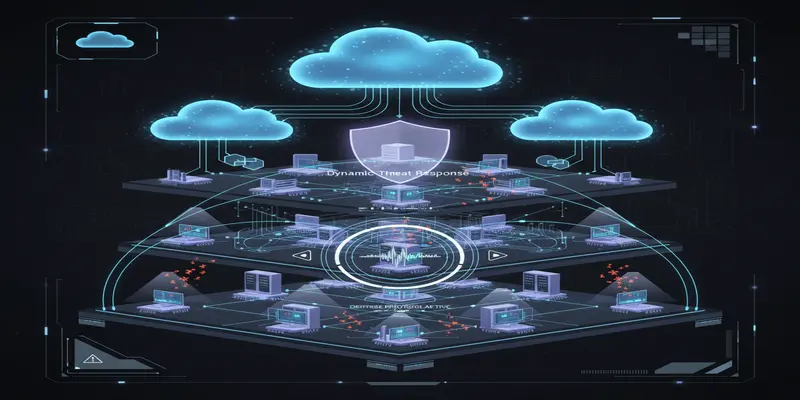
Microsoft AI Agents Redefine Enterprise Security Posture
Executive Summary
Microsoft has launched a transformative cybersecurity model centered on intelligent agents, signaling a foundational change in how enterprise security postures must evolve. These AI-driven agents go beyond traditional automation, fueling a new architecture that demands decentralized enforcement, real-time actionability, and proactive operations. As detailed in this threat intelligence report, organizations must strategically realign operational baselines, telemetry integration, and AI guardrails to remain resilient in the new threat paradigm.
What Happened
On January 21, 2026, Microsoft introduced a new security paradigm powered by the evolution of AI "agents" — intelligent, task-oriented digital actors that move beyond static automation. These agents are designed to operate independently, access real-time data, and make context-aware decisions aligned with enterprise goals.
These developments were announced via Microsoft’s official Security blog, where the Microsoft Defender Security Research Team outlined how agents can dynamically influence an organization’s security posture. Rather than relying solely on signatures, policies, or static logic, these agents can automate detection, response, code validation, and even human collaboration, becoming core enforcement entities across device, identity, and data layers.
This approach reshapes how cyber defense is orchestrated, with composable, multi-agent systems acting autonomously to track posture changes and mitigate threats in real time.
Why This Matters for CISOs
For security leaders overseeing complex cloud-first or hybrid infrastructures, Microsoft’s model represents a major shift from perimeter-based architectures to adaptive, agent-driven security. The integration of AI security agents enables real-time posture decisions — often executed outside of traditional SIEM or XDR pipelines.
CISOs must evaluate how these agents impact enterprise governance, especially in regulated environments where interpretation, enforcement, and risk visibility are tightly coupled with auditability. With Microsoft highlighting agent interactions across M365, Defender, and Entra, cybersecurity governance must now account for deeper collaboration between AI policy, role-based access control, and adaptive trust models. As enterprises adopt more SaaS-connected ecosystems, cloud security threats will evolve from static misconfigurations to dynamic agent behavior drift.
Threat & Risk Analysis
Microsoft's upgraded agent architecture expands both capabilities and potential attack vectors. While designed to improve defense, these intelligent systems also introduce high-value targets for adversaries:
-
Attack Vectors:
- Adversaries may exploit agents through prompt injection, API tampering, or corrupt intent inference layers.
- AI agents operating autonomously could be misled with adversarial data, triggering harmful actions or exposing sensitive contexts.
-
Exposure Scenarios:
- If agents are delegated excessive permissions to conduct actions across endpoints or tenants, lateral movement and privilege escalation risks increase.
- A compromised agent interacting with sensitive M365 flows (e.g., HR, finance, legal) could exfiltrate high-trust data under valid policy.
-
Supply Chain Relevance:
- Open agent orchestration frameworks may include third-party plugins or dependencies that expand the attack surface, akin to traditional supply chain risks.
- In federated collaboration environments, agent decisions across tenants may violate implicit data boundaries or policies.
-
Attacker Motivations:
- Nation-state actors and orange teams may attempt to hijack or reverse-engineer AI agents to monitor security automation patterns and delay response mechanisms.
- Preventing agent misuse becomes as critical as preventing code injection.
-
Enterprise Impact:
- The shift from static controls to interpretive, goal-based agents undermines traditional audit trails and forensics if not properly architected.
- Organizations relying heavily on default configurations or plug-and-play AI functionality risk obfuscating security responsibility.
To maintain cyber hygiene in this new landscape, CISOs should reinforce telemetry validation, implement agent policy isolation, and mandate fail-closed defaults in event-driven architectures. Refer to our daily cyber threat briefings for ongoing patterns in AI-adjacent agent threats.
MITRE ATT&CK Mapping
-
T1059 — Command and Scripting Interpreter
Adversarial agents may execute scripts or commands under autonomous actions. -
T1203 — Exploitation for Client Execution
Malicious payloads could exploit agent workflows in endpoint environments. -
T1565 — Data Manipulation
AI agents could unknowingly alter security configurations or validations based on tampered logic models. -
T1609 — Container Administration Command
Agent orchestration via containerized infrastructure may be manipulated to escalate in CI/CD pipelines. -
T1589 — Gather Victim Identity Information
Agents interfacing with identity layers (Entra ID) may unwittingly leak user or role context if misconfigured. -
T1078 — Valid Accounts
Agents acting with broad entitlements may be leveraged through stolen or replayed credentials.
Key Implications for Enterprise Security
- Agent-based AI policies require new forms of risk modeling and trust delegation beyond classic ACLs.
- Collaboration between security ops and AI ethics/governance teams will be crucial to maintain posture integrity.
- Attack detection must shift from signature patterns to behavioral anomalies within agent frameworks.
- Human oversight loops need to be formalized to intervene or approve agent-led decisions tied to critical data systems.
Recommended Defenses & Actions
Immediate (0–24h)
- Audit deployed AI or task-automation agents for permissions, data access links, and logic exposure.
- Establish baseline telemetry for agent-driven actions — log decision paths, intent evaluations, and result outcomes.
Short Term (1–7 days)
- Integrate agent action reviews into security governance processes — especially for identity and document-driven automation flows.
- Begin implementing composable policy validation for agents that spans identity, endpoint, and cloud interaction layers.
Strategic (30 days)
- Define a centralized agent governance framework — incorporating red-teaming, agent isolation principles, and ethics testing.
- Update supply chain policy to include AI agent components and dependencies in third-party risk assessments.
- Train security teams on adversarial prompt patterns and response control within zero-trust agent architectures.
Conclusion
CISOs must now contend with a new operational reality where autonomous AI agents actively shape enterprise posture in real-time — not as tools but enforcement actors. Balancing their capabilities with risk containment strategies, governance oversight, and realistic ethical boundaries is non-negotiable. As this cybersecurity report illustrates, the institutions that prepare defensively today will define secure operations tomorrow.
Start Your 14-Day Free Trial
Get curated cyber intelligence delivered to your inbox every morning at 6 AM. No credit card required.
Get Started Free